11 free AI traders for Claude.
One scans almost 6,000 US stocks. One reads the news. One tells you when to get in, one when to get out. And one replays your trade 10,000 times before you risk a dollar. Nothing is bought without your yes.
Made by Jake Schincariol: The Day Trader skill, free and open source. No signup, no API key. I ran it on real market data, start to finish.
On your phone? The skills run on a computer. Open federicodonatone.com/trade there, or .
- Chart Scanner
- News Monitor
- Entry Timer
- Exit Planner
- Time Machine
- Budget Manager
- Risk Manager
- Order Executor
- Price Alerts
- Earnings Analyst
- Pelosi Tracker
- Your yes
Eleven traders, eleven jobs
A skill is a set of instructions that Claude reads when the task needs it. These eleven come with small Python tools that read free public data: Yahoo Finance charts, Nasdaq's lists of US stocks, SEC filings and the House Clerk.
01Chart Scanner
/trader-scannerScans almost 6,000 US stocks for setups: opening-range breakouts, flags, oversold bounces.
02News Monitor
/trader-newsReads the headlines and the SEC filings of every stock you watch, and tags what moves it.
03Entry Timer
/trader-entryWatches a setup bar by bar and tells you the moment to get in.
04Exit Planner
/trader-exitSets your stop and your target before you buy, so you know when you get out.
05Time Machine
/trader-timemachineReplays the rest of the day 10,000 times from the stock's own recent bars, and gives you the odds.
The best one06Budget Manager
/trader-budgetSizes each trade to your budget and to the most you are willing to lose.
07Risk Manager
/trader-riskChecks every order against your limits. Anything over them is blocked.
08Order Executor
/trader-brokerSends an order to your broker only after your yes. Paper trading by default.
09Price Alerts
/trader-alertsRings at your stop, at your target, and before the close.
10Earnings Analyst
/trader-analystReads earnings reports from SEC filings and sums up what changed.
11Pelosi Tracker
/trader-pelosiReads the stock trades members of Congress must disclose, as soon as they are filed.
One trade, in order: 📈 → 📰 → ⏱️ → 🚪 → ⏳ → 💰 → 🛡️ → 🧾. While it is open: 🔔. On their own schedule: 📰 📊 🏛️.
One real TSLA test, start to finish
I ran the tools on the real market data of that Monday, with the clock set to the morning, in a clean test folder. I never said yes, so nothing was bought.
-
📈
1 · Chart Scanner · 10:15 AMOf the 200 it checked, 128 broke out
5,944US stocks read1,575looked like breakouts200most traded of those, checked with real highs and lows128broke outA breakout here is a 5-minute bar that closes above the stock's high of the first 15 minutes. TSLA was one of the 128: it broke out at 9:55 AM. A scan is a list of charts that match a rule. It is never a list of stocks to buy.
-
⏱️
2 · Entry Timer · 9:55 AMTriggered at $393.82
Opening range, 9:30 to 9:45 AM: $383.84 to $393.74. The 9:50 bar closed at $393.82, 8 cents above it. Only the bars up to the entry are shown. It waits for a bar to close above the range. A spike in the middle of a bar does not count.
-
🚪
3 · Exit Planner · before buyingThe stop and the target, set first
Target: one times the risk$398.85Entry$393.82Stop: the middle of the range$388.79Risk: $5.03 a share. Out by 3:55 PM either way, so nothing is held overnight.
-
⏳
4 · Time Machine · the best oneThe rest of the day, replayed 10,000 times
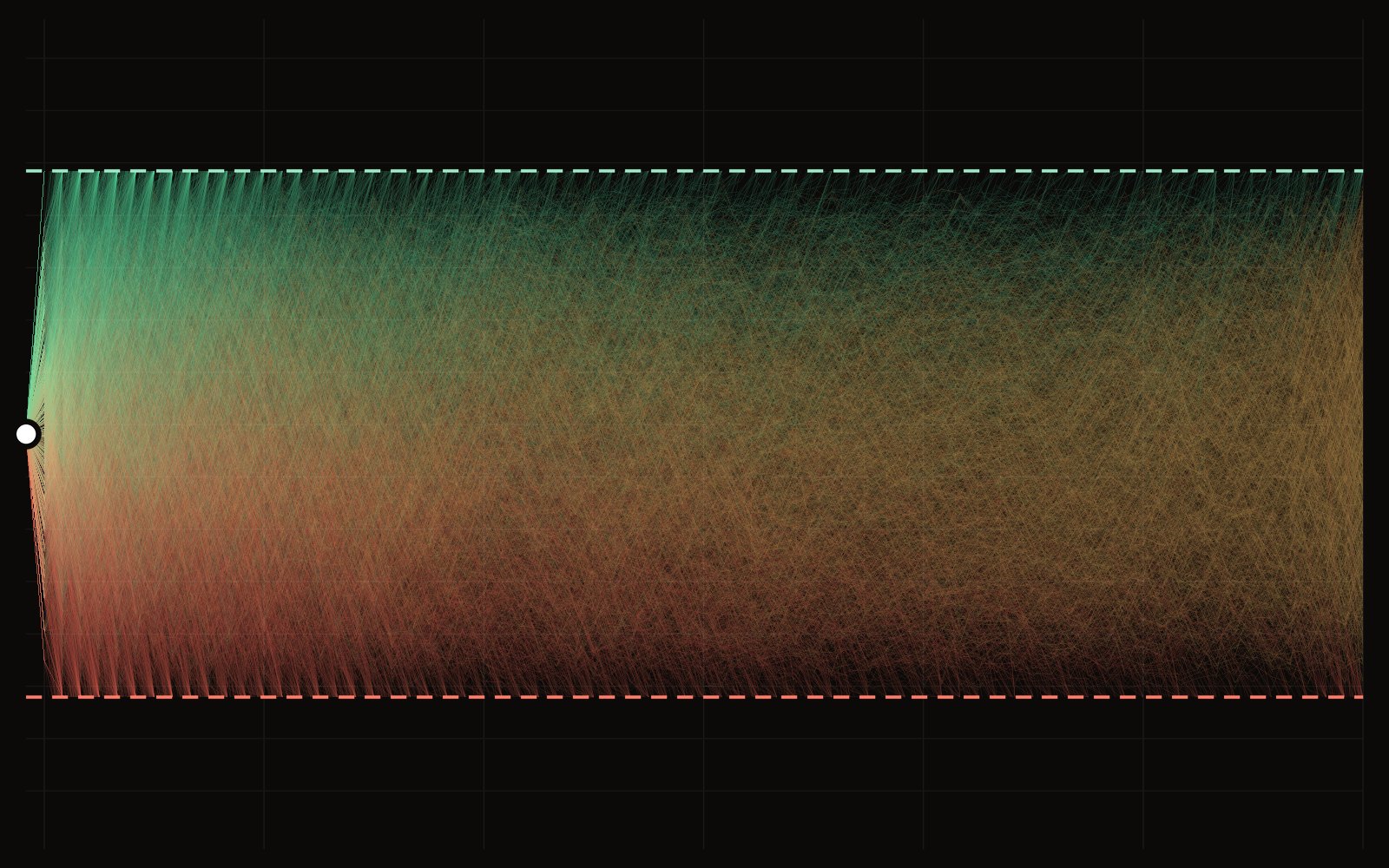
9:55 AMEach line is one replay4:00 PM 46.9%hit the target first35.0%hit the stop first18.1%hit neither by 4:00 PMIts verdict, word for wordLeans toward the target: target first 46.9 % vs stop first 35.0 %.
Every replay is built from TSLA's own 5-minute bars of its last 59 sessions. It also ran the same rule on those 59 real days: it fired 36 times, 14 hit the target, 16 the stop, 6 neither. That real record leaned a little the other way, and the tool shows both.
-
💰
5 · Budget Manager + 🛡️ Risk Manager9 shares, sized to a $50 loss
$5,000account$50max loss a trade9shares, $3,544.38PASSrisk checkThe stop decides the size: 9 shares lose $45.27 if the stop fills at $388.79. The risk check then tested the order against every limit: max loss, daily loss, trades per day, the hours, reward to risk.
-
🧾
6 · Order ExecutorA paper ticket, waiting for my yes
PAPER account · Alpaca✋ Nothing was placed
BUY 9 TSLA · market · good for today
stop-loss 388.79 · take-profit 398.85
Ready. It needs your yes for this one order.Only this skill can lead to an order, and only after the risk check passes it and you type yes for that one order. Then Claude's own permission card asks you again.

The honest fine print
- Not financial advice. This is software that reads public data and does math. Jake's own guide says most people who day trade lose money. You can lose money.
- Nothing is bought without your yes. Paper trading is the default. Real money only if you switch it yourself, in your own settings.
- The Time Machine is a simulation. It replays the day from the stock's own recent bars. It cannot see earnings, news or a halt, so its odds are a reality check and never a promise.
- A stop can fill worse. In a fast market or across a gap, a stop order can fill well past its price.
- The data is free and unofficial. Yahoo Finance charts can lag or change. Check anything that matters with your broker.
- One test, one day. My run shows that the tools work. It does not show that the strategy makes money.
Get the link and my setup guide
- The link to the 11 skills, with a copy button. Free, MIT, no signup, no API key.
- How to install them in Claude or in Claude Code. I tested it today in a clean sandbox: all 11 in 2 seconds.
- My setup guide: your limits, the one line the SEC asks for, and a paper broker that waits for your yes.
- Your first run, step by step: the prompts that replay my TSLA test, and what the Time Machine can and can't tell you.
Install the 11 in Claude
Three ways, all free. Pick the one that fits how you use Claude.
Locked. The link, the two commands for Claude Code and the line that copies the folders open with your email.
Open it with your emailSet your limits first
Your budget, the most you lose on one trade, the hours you trade. The skills read them before every order.
Locked. My config file, line by line, and the one line the SEC asks for.
Open it with your emailA paper broker that waits for your yes
The Order Executor can send orders to Alpaca, on a paper account with simulated money. Here is how to connect it safely.
Locked. The Alpaca setup, the permission that makes Claude ask before every order, and the tools to block.
Open it with your emailReplay my TSLA test, step by step
Seven prompts, in order. Each one shows what it printed on 26 Oct 2026.
Locked. The seven prompts, what each one printed, and how to run the same steps on a live day.
Open it with your emailWhat the Time Machine is and is not
How it builds 10,000 replays from real bars, and what it can't see.
Locked. How the replays work, how to read the odds, and why the real history matters.
Open it with your email